Wednesday, June 6, 2012

Directing Menschen

Only a few days ago, I wrapped production on MENSCHEN my first independent short film. Compared to my prior films the scale of Menschen was even more epic than the usual costume drama I've come to be known for. The intensive 8-day shoot brought a lot of challenges that the cast and crew overcame at every turn. For my role I had to adapt a lot to direct working with a language I was not fluent in and working with a young actor with Down Syndrome among other things.

Menschen takes place in WWII but it is hard to compare it to my other film from the period The Last Bogatyr (a surreal film which takes place on the Russian front). Menschen is a narrative work of fiction around an Austrian captain in the Wehrmacht who takes a developmentally disabled boy under his wing in his journey to surrender to the Americans. The word "menschen" is German for human beings, a word I'd come across that conveyed the value of the individual regardless of their background. In 2010, Menschen was a concept for feature, a four page treatment and an unfinished screenplay. Two years later, I completely rewrote the script and was foraging ahead into production for Menschen as a short.

I have been really blessed with an array of talented people on board the production, first and foremost my producers Anastasia Cummings and Robert von Dassanowsky. Some of the events were loosely inspired by stories from Robert's own family history during the era, his support and encouragement never allowed me to abandon the concept. Once Anastasia came on board she moved the production along in a big way turning it into something far larger than I could have hoped for.

It was always on my mind to have Menschen in German. I have a great passion for history and as a filmmaker I feel responsible to be as true to the culture and period as possible. The screenplay was translated numerous times to the point of tweaking words on set to make them more true to the Austrian dialect. We spent a lot of time in casting to find German speaking actors who could fill the roles of  Menschen's Austrian and German characters. Our dialect coach Adrian Kadanka worked to perfect the Austrian accent with the actors. During the shoot we were blessed with Anastasia and our own Austrian Director of Photography Peter Wigand who lent their fluent ear to the dialogue as well.


The experience of watching your words come to life is always fulfilling, in my case I was hearing them for what felt like the first time in German. I picked up on key words and the cues in blocking in order to keep up with the action in each scene. For the most part what I had to draw direction from was the actors' body language. If I had to give a note on a line I almost always referred to the english version of the line.

What has always attracted me to directing is the beauty between choreographing the movement between camera and talent--in many ways it is a meticulous and well grafted dance.  I realized when I began working with Peter Wigand he had so much to offer the film. I appreciated the way he had an eye not only for translating the emotional narrative to screen, but also for representing his national heritage on our set. I think in many ways he really enhanced my vision for Menschen. During one of the days while we were in Black Forest, Peter introduced a way to capture the entire scene in a single moving shot. While it sound sounds simple, the move is something I think very few directors of photography could pull off as easily as Peter did. Moving the camera seamlessly from actor to actor and pulling the focus with only his eye for reference encapsulates the beauty from both sides of the camera.

The unique angle in Menschen's narrative was always the film's perspective on disability. Films predominately featuring individuals with disability are rare enough and novel to the WWII genre. Historically they were targeted in the Nazi's T-4 program, in Menschen there is a story of hope of how one such individual was preserved from the purges.  I'm rather sensitive to special needs because my own brother and sister have disabilities. My brother and sister are rather severe, although they have Down Syndrome my sister's Autism has created a lot of behaviors we as a family are still working to manage. When it came to casting the role of the Czech boy Radek, I was searching for an actor with Down Syndrome. When we first saw Connor Long, I was blown away by his performance.

Just 17-years old, Connor has achieved so much as an athlete and leader in his own community. I remember watching him in auditions as he brought the actress reading with him to tears. I thought to myself there is something precious and genuine in his performance that is really going to read on screen. As the production moved on Connor really took the hearts of all those who worked with him. He had a big smile and slick sense of humor.

I really bonded with Connor, whenever I turned around there he was smiling at me and telling me I was beautiful (what girl wouldn't fall for that one). The role of Radek required Connor to really bring out behaviors and trauma in his performance. I'd discuss ideas with his parents that they would rehearse with him at home, then on set I would refine his performance. Connor and I made a game out of it at one point: I became his mirror. I stood off-camera at his eye-line and emoted or moved in the way I wanted him to reflect for key moments in the film. On the very last day shooting we approached his scene in this way for the final farewell and this time I was the one who was brought to tears by his performance.

Looking back I'm still amazed by all we were able to accomplish for Menschen. I had learned from working with WWII re-eanctors and pyrotechnics teams on The Last Bogatyr what to prepare for to direct large scenes with background and visual effects on site. We started off production with a bang (quite literally) with the bombing of the Wehrmacht convoy and we closed the film on just as large a note with an elaborate setup for the American camp and POW enclosure. I am so grateful to the production design team and support from the WWII re-enacting groups for what they brought to the production value of the film. As I prepare myself to enter post-production, I can only sigh and smile for all I have gained from this incredible shoot. A director is only as good as the people supporting them and I am so very proud of each and everyone's contribution to Menschen, it shows in the footage.


Tuesday, October 25, 2011

The Offer He Couldn’t Refuse: The Godfather and Coppola’s Compromise of Capitalism in American Cinema


”He’s a businessman, I’ll make him an offer he can’t refuse”, are the iconic words of the Godfather, Don Vito Corleone that also illustrate the business behind the studio system which ushered in Francis Ford Coppola’s enduring masterpiece The Godfather in 1972. Struggling to compete with the television programming and a new generation’s cinematic appetite that favored risqué and gritty foreign films, the studios were desperate for a genuine blockbuster. Paramount studios turned to a young film school graduate and independent filmmaker Francis Ford Coppola to adapt the popular best seller The Godfather. Faced with debts and the future of his fledgling independent film company; American Zoetrope, Coppola was coerced into directing The Godfather (Schumacher 88). Coppola focused on imprinting a realistic picture of American capitalism through a mafia family’s collapse and rebirth. The reshaping of the Corleone clan infrastructure from Don Vito Corleone’s old world values to his younger son’s gritty and aggressive approach characterize American Cinema’s transition through the generation of New Hollywood filmmakers like Francis Ford Coppola.
            A melodrama of one family’s survival to stay on top, The Godfather captures the authentic Italian-mob culture through Coppola’s own Catholic and Italian heritage. The charming, aged patriarch, New York crime boss, Don Vito Corleone (Marlon Brando) hears the petitions from the serfs of his feudal clan around the pleasantries of his daughter’s wedding celebrations. He peers out at his empire from the discretion of blinds and marks the return of his youngest and favorite son Michael (Al Pacino) a WWII hero, bringing along an outsider, his non-Sicilian, all-American girlfriend Kay Adams (Diane Keaton). One member of “the family” celebrity Johnny Fontane (Al Martino) comes to Vito desperate for him to jumpstart his career. Vito sends his adopted son, the cool calculating, Tom Haggard (Robert Duvall), the family consigliere (legal counselor) to Hollywood to make the difficult producer an offer he “cannot refuse”.
            The tide turns for the Corleone family when Vito takes and old world stand against a rival crime boss’ offer to go into the drug trade. Sollozo (Al Letierri) the rival crime boss soon targets Vito and his men shoot up the Corleone Don in the street. Michael is drawn into the family business as his older brother the hotheaded Sonny (James Caan) triggers the first mob-war in ten years. Michael is nominated to mediate for ‘the family’ and uses the opportunity to assasinate Sollozzo and his corrupt police captain counterpart and then flees to Sicily. Leaving Kay behind he falls in love and marries a fragile Sicilian girl from his father’s native town. When Sonny is lured to his death at a tollbooth shoot out, and Michael’s wife is killed with a car bomb intended for him, the weak Don Vito negotiates a truce for Michael’s return compromising to engage in the drug trafficking, a vice he considered unethical before.
            Michael returns a hardened man. He marries Kay and has a son with her, but he moves swiftly with Machiavellian agency to reinstate the Corleone family’s power. Vito is able to impart to Michael his final insight on how the rival crime families will attempt to entrap him when he is gone. While playing with his grandson Vito dies in the vineyard. Now don, Michael stands in as godfather at his nephew’s christening while rivals to their ‘family’ are assassinated. The film closes with Kay’s realization that she is cut off from her husband by the family of men that encompass him and literally close the door on her.
            The narrative themes of honor, greed, and ambition in the film go beyond the mafia backdrop and paint a picture of capitalistic American values. The Corleone family is the story of “American expansion and capitalism in the twentieth century” (Dauth 2). In contrast to the “goonish stereotypical mobsters” in old gangster films Coppola’s smooth, professional, mafia in The Godfather becomes more “like a corporation in a corporate society” (Phillips 109). Even in the ritualistic depiction of the Catholic rituals the mafia’s involvement visually strikes the viewer as a well-oiled machine. At Vito’s funeral several men step out of their cars in sequence bearing aloft a single red rose. The “profit driven culture” of 1970s America is reflected in the aggressive ambition of Michael to overcome his competition (McBee 102).
Coppola’s stylistic mark reflected fresh cinematic innovation as well as subtle throwbacks to techniques from classical art. Coppola fought for the film be shot on location in New York and Italy over the Hollywood back lot, the result is an authentic gritty realism reminiscent of the style of the Italian Neo-Realist filmmakers (Phillips 92, Braudy 18). Stylistically low-key lighting gave The Godfather its recognizable texture to the film’s sinister figures and action. The godfather’s office is shrouded in shadow in contrast the sunny brightly lit wedding taking place outside. The business of the mafia is marked by darkness: “the don is the personification of evil”, explains cinematographer Gordon Willis (Phillips 99). Sound engineer Walter Murch draws attention to the diagetic sound of screeching of train brakes that trigger Michael’s murder of Sollozzo as a “metaphor for Michael’s anxiety” (Phillips 103). Within the mise en scene Coppola embeds a throwback to classical art via memento mori (a reminder of death). In many renaissance portraits the presence of fruit signifies the potential decay of death, in The Godfather the motif of oranges in the frame become Coppola’s memento mori particularly at moments leading up to violence, like the bag of oranges Vito drops right before he is shot.  
A critically celebrated film and a blockbuster at the box office, The Godfather reeled in three Oscars including ‘Best Picture’. The film’s success firmly established Coppola’s career as an auteur and gave him the freedom to actively pursue his following films and launch the careers peers like George Lucas on their next venture with American Graffiti (Schumacher 127). In hindsight of the production battles Coppola out maneuvered to make The Godfather the powerful film that it remains today, I cannot help but see an allegory between the mafia families and the Hollywood studios with Coppola as Michael foraging forward with the new generation’s alternative filmmaking in American Cinema.
Works Cited
Braudy, Leo. "The Sacraments of Genre: Coppola, DePalma, Scorsese." Film Quarterly 39.3 (1986): 17-28. Jstor. Web. 13 Oct. 2011.
Dauth, Brian. "Great Directors Francis Ford Coppola." Senses of Cinema 7.39 (2006): 1-12. Senses of Cinema. Web. 14 Oct. 2011.
McBee, Randy D. "Hollywood, The Working Class and Emotional Realism." Reviews in American History 32.1 (2004): 97-104. Jstor. Web. 14 Oct. 2011.
Nystrom, Derek. "Hard Hats and Movie Brats: Auteurism and the Class Politics of the New Hollywood." Cinema Journal 43.3 (2004): 18-41. Project Muse. Web. 14 Oct. 2011.
Phillips, Gene D. Godfather: the intimate Francis Ford Coppola. Lexington: The University Press of Kentucky, 2004. Print.
Schumacher, Michael. Francis Ford Coppola: a filmmaker's life. New York: Crown Publishers, 1999. Print.
The Godfather (Coppola Restoration) [Blu-ray]. Dir. Francis Ford Coppola. Perf. Al Pacino, Marlon Brando, Robert Duvall. 1972. Paramount Home Entertainment, 2010. DVD.


Monday, October 10, 2011

The Femme Fetale between Jules et Jim


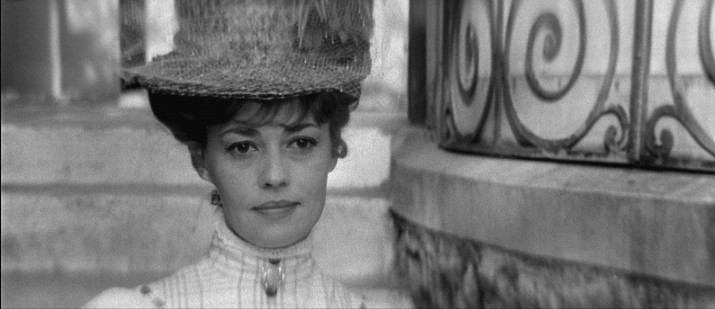
One of the most influential films of the New Wave is Francois Truffaut’s Jules et Jim (1962). The film follows the destruction of a bond between two men through the woman who comes between them. Truffaut captures the love triad between Jules, Jim and Catherine from the turn of the 20th century through a world war and into the roaring twenties. The time frame parallels the change in culture with the fluctuation of love between the characters. Through the period piece Truffaut depicts the dangers of a down to earth femme fetale, Catharine, through her transformation into the modern woman.
Jules is a foreigner in Paris, an Austrian, and a man very much naive about the vices of women. His best friend on the other hand Jim is a Parisian, a flagrant womanizer who always seems to return to his faithful mistress Gilberte. Jules and Jim are drawn to Catharine initially not for her complete self, but because of her resemblance to a statue they are fixated with. She had the same enigmatic smile as the statue. Jules marks her as the woman he wants to spend the rest of his life with, going to the extent of warning Jim off in the famous line: “Not this one, Jim”. When Jules discusses the prospect of marriage, Jim sees the reality and warns: “I’m afraid she’ll never be happy on this earth. She’s a vision for all, perhaps not meant for any one man alone”. Jim suppresses his attraction to Catherine out of difference to Jules. Shortly after Jules marries Catharine, the First World War breaks out and separates the two friends for the time being.
Catharine refuses to live life by the rules. She dresses in drag wearing the clothes of a boy with a grease moustache on an outing with Jules and Jim. They race across a bridge; however, Catharine cheats to get a head start. Later when she hears Jules talking to Jim about traditional marital expectations that the woman’s fidelity is more crucial than the mans, Catharine protests by leaping into a canal fully robed. Her impulsive act is foolhardy and irrational. She never explains her actions when Jules and Jim fish her out. The reference in the dialogue about marital roles foreshadows how Jules will be forced to eat his own words later when he is cuckolded over and over again by Catharine’s whims.
Obsessed with vengeance, Catharine believe she must get “even” with every perceived injustice done to her. She does not take into consideration whether it was intentional or circumstantial injury, but seeks to punish her perceived persecutor nevertheless. Catharine later justifies herself to Jim when he visits their Chalet on the Rhine after the war that because Jules’ mother had offended her at their wedding she cheated on her wedding night with an old flame in order to be even with Jules.
Catharine’s selfishness fuels her agency. She dominates her marriage with Jules. He tolerates her every whim with patience lest he loose her completely. When Jim visits their Chalet, Jules even offers Catharine to him in marriage so that she will not be “taken away from him” by another man. The love triad is not a permanent solution, because Jim finds himself jealous of his friend when Catharine chooses to seduce Jules on whim and Catharine grows disillusioned when she cannot have Jim’s child. She becomes self-destructive spurning Jim in the fear that one day he will leave her for a younger woman now she is no longer young.
In the late 1920s, Jules and Catharine move back to France with their daughter Sabine and by that time Jim has let Catharine go deciding to marry the woman who has waited for him all along, Gilberte. Catharine cannot handle loosing Jim and soon grows restless. Jules tells Jim that she is depressed and has purchased a revolver. One day Catharine drives her car off the road around the trees outside Jim’ apartment. She lures him to her bedroom but when Jim refuses to sleep with her. Instead he points out to her the sacrifices he made for her that she was unwilling to make in return, but in the end Catharine cannot see beyond herself. She asks him “What about me?” cries and then turns on Jim pulling her revolver on him. Jim barely escapes by jumping from a window.
A few months later Catherine triumphs when Jules, Jim and her have a chance encounter at a movie theater. Afterwards Catharine lures Jim into her car on the pretext of “having something to tell him” and then coyly tells her husband to “watch them closely”. Jules watches and to his horror Catharine drives her car quite intentionally off a broken bridge taking Jim’s life along with her own. In that act Catharine defines the femme fetale – the fatal female.
As a liberated woman who does as she pleases Catharine compromises her family and the friendship between Jules and Jim. As time passes and the dresses get shorter and shorter, Catherine grows bolder and bolder. She wraps her lingerie in a package before Jules and Jim before leaving them to openly have an affair with another man. Perhaps Truffaut is attempting to illustrate the dangers of gender role reversals. In their marriage Catharine could arguably be the one who wears the pants. She drives the car and is she who has numerous infidelities. Truffaut defines a down to earth yet very volatile femme fetale in his characterization of Catherine in Jules et Jim.