Showing posts with label French New Wave. Show all posts

Monday, October 10, 2011

The Femme Fetale between Jules et Jim


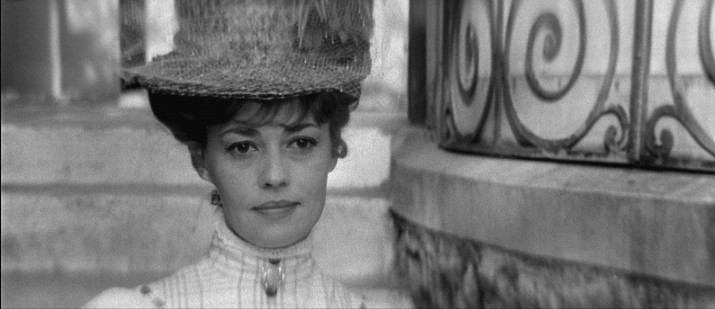
One of the most influential films of the New Wave is Francois Truffaut’s Jules et Jim (1962). The film follows the destruction of a bond between two men through the woman who comes between them. Truffaut captures the love triad between Jules, Jim and Catherine from the turn of the 20th century through a world war and into the roaring twenties. The time frame parallels the change in culture with the fluctuation of love between the characters. Through the period piece Truffaut depicts the dangers of a down to earth femme fetale, Catharine, through her transformation into the modern woman.
Jules is a foreigner in Paris, an Austrian, and a man very much naive about the vices of women. His best friend on the other hand Jim is a Parisian, a flagrant womanizer who always seems to return to his faithful mistress Gilberte. Jules and Jim are drawn to Catharine initially not for her complete self, but because of her resemblance to a statue they are fixated with. She had the same enigmatic smile as the statue. Jules marks her as the woman he wants to spend the rest of his life with, going to the extent of warning Jim off in the famous line: “Not this one, Jim”. When Jules discusses the prospect of marriage, Jim sees the reality and warns: “I’m afraid she’ll never be happy on this earth. She’s a vision for all, perhaps not meant for any one man alone”. Jim suppresses his attraction to Catherine out of difference to Jules. Shortly after Jules marries Catharine, the First World War breaks out and separates the two friends for the time being.
Catharine refuses to live life by the rules. She dresses in drag wearing the clothes of a boy with a grease moustache on an outing with Jules and Jim. They race across a bridge; however, Catharine cheats to get a head start. Later when she hears Jules talking to Jim about traditional marital expectations that the woman’s fidelity is more crucial than the mans, Catharine protests by leaping into a canal fully robed. Her impulsive act is foolhardy and irrational. She never explains her actions when Jules and Jim fish her out. The reference in the dialogue about marital roles foreshadows how Jules will be forced to eat his own words later when he is cuckolded over and over again by Catharine’s whims.
Obsessed with vengeance, Catharine believe she must get “even” with every perceived injustice done to her. She does not take into consideration whether it was intentional or circumstantial injury, but seeks to punish her perceived persecutor nevertheless. Catharine later justifies herself to Jim when he visits their Chalet on the Rhine after the war that because Jules’ mother had offended her at their wedding she cheated on her wedding night with an old flame in order to be even with Jules.
Catharine’s selfishness fuels her agency. She dominates her marriage with Jules. He tolerates her every whim with patience lest he loose her completely. When Jim visits their Chalet, Jules even offers Catharine to him in marriage so that she will not be “taken away from him” by another man. The love triad is not a permanent solution, because Jim finds himself jealous of his friend when Catharine chooses to seduce Jules on whim and Catharine grows disillusioned when she cannot have Jim’s child. She becomes self-destructive spurning Jim in the fear that one day he will leave her for a younger woman now she is no longer young.
In the late 1920s, Jules and Catharine move back to France with their daughter Sabine and by that time Jim has let Catharine go deciding to marry the woman who has waited for him all along, Gilberte. Catharine cannot handle loosing Jim and soon grows restless. Jules tells Jim that she is depressed and has purchased a revolver. One day Catharine drives her car off the road around the trees outside Jim’ apartment. She lures him to her bedroom but when Jim refuses to sleep with her. Instead he points out to her the sacrifices he made for her that she was unwilling to make in return, but in the end Catharine cannot see beyond herself. She asks him “What about me?” cries and then turns on Jim pulling her revolver on him. Jim barely escapes by jumping from a window.
A few months later Catherine triumphs when Jules, Jim and her have a chance encounter at a movie theater. Afterwards Catharine lures Jim into her car on the pretext of “having something to tell him” and then coyly tells her husband to “watch them closely”. Jules watches and to his horror Catharine drives her car quite intentionally off a broken bridge taking Jim’s life along with her own. In that act Catharine defines the femme fetale – the fatal female.
As a liberated woman who does as she pleases Catharine compromises her family and the friendship between Jules and Jim. As time passes and the dresses get shorter and shorter, Catherine grows bolder and bolder. She wraps her lingerie in a package before Jules and Jim before leaving them to openly have an affair with another man. Perhaps Truffaut is attempting to illustrate the dangers of gender role reversals. In their marriage Catharine could arguably be the one who wears the pants. She drives the car and is she who has numerous infidelities. Truffaut defines a down to earth yet very volatile femme fetale in his characterization of Catherine in Jules et Jim.

Friday, October 7, 2011

Cinematic Reincarnation: Hiroshima Mon Amour


The universal themes of love, loss, and memory transcend dimension in Alain Resnais’ tour de force masterpiece Hiroshima Mon Amour (1959). Thrust together by need and desire Elle a French actress and Lui a Japanese architect share a one night stand in Hiroshima and delve into a didactic on their very different, but also very similar world experiences. Resnais creates a hybrid film overlapping between the documentary, unrequited love-story, and even pushing the envelope through the metaphysical aspects of Hiroshima Mon Amour.
There are overwhelming references to rebirth and perhaps even reincarnation within Resnais’ film. The opening image that the credit runs over is a still of a plant growing out of the sand. During the opening documentary montage of Elle and Lui’s didactic on the catastrophe of the atomic bomb, Resnais returns to that same image when Elle alludes to “new vegetation rises from the sands”. This time we see beside the plant a cigarette box with the words “Peace” printed on it.
The bond that forms between Lui and Elle also alludes to something rising out of the ashes. From the moment that Elle sees Lui’s hand lying in bed the morning after their tryst, she immediately ties the connection to her first love 15 years back in WWII. Resnais conveys this with a jump cut insert as if we the spectator where in Elle’s mind pulling up the memory with her. Later when Elle concedes to give in to Lui’s desire to be with her again, she unravels little by little the significance of her first love with a Bavarian soldier during the occupation of France in a quiet little city: Nevers. She begins to project the soldier onto Lui recounting the experience by saying things like “You are dead”. Lui encourages her to tell her whole story by reinforcing the illusion and asking “Am I dead?” in order to keep his place in Elle’s non-linear recounting of events.
By the end of their revelation Elle decides it is best to part ways in their conversation she admits there is very little likelihood that they will ever see each other again unless there is “another war”. The significance of the reference to war and the catastrophic losses that brought them together is in a way another reference to the theme of rebirth. During the film’s opening montage when Lui and Elle are exchanging counterpoints while making love Elle says over and over again “you’re destroying me you’re good for me”. Her paradoxal statement epitomizes the consequences of forbidden love and sweetness of it in her own life. Her liaison with both the Bavarian and the Japanese man are liaisons with the international “other”. Japan and Germany were allies to each other during WWII and in the post-war world an inter-racial union with either would be considered risqué.
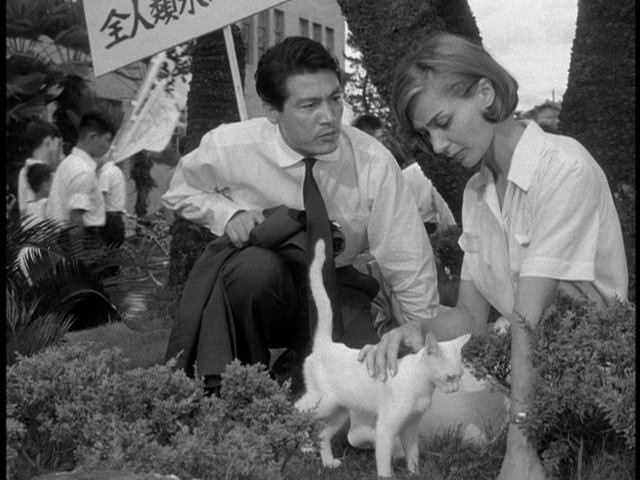
Resnais balances feelings of familiarity through contrasting symmetry. The black cat that shares Elle’s isolation in the cellar is mirrored by the white cat she pets on the set of the film. In editing Resnais parellels the significance of identity through a place origin when shots of Nevers and Hiroshima are intercut together.The link to the Bavarian soldier is established because Elle sees him in the way Lui lies in bed asleep.

Contracted to do a film on the atomic bomb, Resnais instead chose to show the catastrophic aftermath of the experience of the bomb through the individual. His non-linear narrative conveys a very tactile experience for the spectator through the inter-cutting of inserts that correspond to Elle’s description of the abrasive cellar she endured her madness in or the blurred memories of her affair with the Bavarian soldier. The multi-valent layers of narrative and human emotion keeps Hiroshima Mon Amour in the circle of one of my favorite films of all time.

Monday, October 3, 2011

The Irrational Youth of Breathless


One of the defining films of the French New Wave, Jean Luc Goddard’s Breathless is a picture of the irrationality of the youth culture. The film follows the obnoxious Michel on his adventures to collect the money owed to him, evade apprehension by the police and entrap the stubborn independent American girl Patricia to run away with him to Rome.
Through Michel Goddard shows the youth’s self-consummation through the media. At the film’s opening in the car that Michel has stolen he finds a revolver in the glove compartment. Playing up the image of the gangster he hunches over the steering wheel uttering, “Bang, Bang!” as he drives along the country road. Moments later when cop pulls up behind him, Michel shoots him dead with the same revolver. The connection to cinematic influences are made apparent throughout the film through the enigmatic film score by Martial Solal that echo the intriguing nuances of the classic film noirs out of classic Hollywood. Michel himself is constantly trying to channel Humphrey Bogart. In one scene in the film he stands in the street staring at the star’s headshot, smoking and dragging this thumb across his lip in mimicry.
Patricia the object of Michel’s desire is an independent American student studying and working simultaneously in Paris. Like Michel she is a free spirit. The way Michel will leave on girl on the pier or steal money from another from under the nose in her apartment, Patricia will also use the men around her to her advantage. She takes a lunch meeting with a journalist who is promising her a story and makes out with him in his car directly after. When she attends a press conference for a famous writer she allows the writer to disregard all her questions and flirt directly with her. Patricia fluctuates between the working-woman in the pants like when she is trying to sell copies of The New York Harold Tribune on the streets of Paris or when she wants to use her feminine wiles to her advantage over men when she is in the Dior dress.
When Patricia discovers the full extent of Michel’s entanglement with the police, she appears to go on the run with him at first, even saying goodbye to the journalist that same night in a café. The morning after they have safely stayed the night in a hideout she goes out on the pretext of getting groceries and informs to the police where Michel is. When she returns to the apartment she confesses to Michel what she has done. The only explanation she can offer him is that she did what she did only in order to prove to herself that she did not love him.
Faced with betrayal Michel succumbs to the death of a tragic hero. Refusing to run off with his friend when the money is delivered. Michel stumbles down the street as the police arrive on the scene and open fire. In the end Michel refuses all rational alternatives and chooses to take on the death of a tragic hero. Patricia’s betrayal is perhaps reflexive of her need to be independent of men. In the end she stands over Michel as he dies unmoved.
The reckless youths of Michel and Patricia overlap in Breathless for a brief interlude only to part ways through an unfortunate turn of events. Perhaps Goddard is trying to show that the youth’s obsession with characters from popular media, are mere attempts to fulfill the writer’s ambition: “to become immortal and then to die”. Goddard’s subtle premise for the future of an irrational youth.

Thursday, September 29, 2011

The Contrasts of female Identity in Cleo From 5 to 7


Agnes Varda’s second film Cleo From 5 to 7 (1962), handles the superficiality and despair a young pop star battles around her own mortality. Varda structures her film around stark contrasts and in doing so ruptures Cleo’s extreme values as her character arcs.
The film opens in color where the camera looms above as the tarot cards are laid out. Cleo tenses and becomes hysterical when the death card is unveiled. She takes it as a sign that she has cancer and is doomed. The shots of her and the fortune teller are in black and white as is the entire rest of the film.
Cleo is placed alongside a cast of supporting female characters that emulate the modern woman – the modern woman Cleo is not comfortable with. When Cleo takes a taxi cab with her assistant, the driver is a woman in man’s clothes. The taxi driver was in the paper for standing up to a gang that refused to pay their fare one night. But to Cleo her risk is “disgusting”, and equally “disgusting” is her friend Dorothee who poses nude for sculptors without a blush. Cleo would much rather stay in her lofty luxurious flat in her ridiculously flamboyant white furred robe and lingerie as if she were a queen with a court waiting upon her.
The flat that Varda has for Cleo in itself is a conflict of values. The modern structure of the flat and its empty whiteness dominates the screen, in contrast to the classical dark furniture pieces sparsely placed about. Her grand post bed and vanity mirror make the room feel more like a stage then a living space. The hollowness of her lifestyle is made apparent even to Cleo. Her lover Jose comes to give her a kiss and completely objectifies her with dismissive pet names. Her pianist and lyricist arrive and play a prank on her to her vexation. When she sings the new song they have written for her she is moved to tears because she realizes that the singer’s dejected despair is her own. This is the turning point of the film, Cleo rejecting a false lifestyle as a femme fragile a feminine object retreats behind a black curtain. In a masterful stark cut from the black curtain, Cleo re-emerges clad in a black modern day dress. She yanks off her hair piece and storms out alone. Visually the transference of mood through color comes across and the white spacious room now seems darker because of the camera’s fixation on Cleo and her dark turn of mood.
Cleo wanders the city on her own feeling the eye of the public on her on the street and not on her enough in the café. She meets up with Dorothee but when her compact falls and cracks on the pavement Cleo again is taken in with fears of her impending death. They come across a scene where the public have gathered around the place of where a man has died. “The mirror was for him”, Dorothee reassures Cleo.
After she has dropped off Dorothee, Cleo orders her taxi to drop her off at a park, she strolls past children until she comes to a bridge beneath a waterfall where she meets an Algerian soldier. He is an intellectual trying to impress her with scientific facts and the mythic significance of their encounter. It is the longest day of summer and they are together. Cleo opens up to the soldier telling him her real name, Florence. She has decided to leave the role of her public identity for him. The soldier compares the two Florence the city of the Renassaince and Goddess of Summer versus Cleopatra a “tigress” and “temptress”. He is able to make her see the frivolity of her vain fears because of where he comes from in the warzone of the French Algiers merely by saying “In Algiers you’d be scared all the time, Dying for nothing that’s what upsets us”. He offers to go with her to hear the results of her tests if she will see him off at the station notices her ring, which catches the attention of more than one man admirer throughout the film. “A pearl with a frog”, Cleo describes it. “You and me”, the soldier concludes. Perhaps Varda is making a subtle reference to the tale of the Frog Prince, where a spoilt young princess unhappy with her life has to be humbled and taught a lesson through the help of frog, a man she perceives is much lower than herself.
Varda turns the power of superstition on its head. The motif of Cleo encounters reinforces the notion of mortality and at the same time the ridiculousness of superstition. At a shop window Cleo is fixated with a black hat. Her assistant Angela will not let her carry it home because it is not good to wear something new on a Tuesday. At the films turning point Cleo decides to spite fate and Angela’s warnings by wearing the black hat out that Tuesday only to eventually give it to her friend Dorothee. The tarot card, black hat, broken mirror, and broken glass window where a man died, Cleo recognizes each to be a momento mori a sign of death. The phrase “momento mori” comes from Latin and translates to “remember your own mortality”.
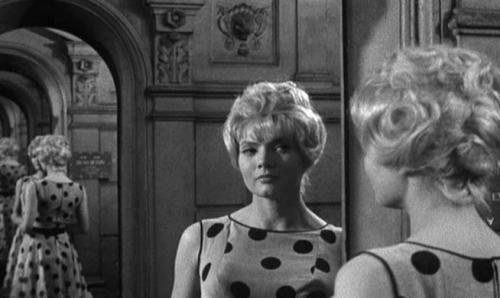
In the early portion of the film Cleo is constantly checking her appearance in mirrors another momento mori from classic art. She is afraid of loosing her looks “Ugliness is a kind of death, as long as I am beautiful I am even more alive than others” Cleo’s internal monologue is shared with the audience. When she perceived what her image means to most of the men around her from her lyricist and pianist to the men lusting after her in the street she feels objectified. She has made herself comfortable as a caged beauty, wandering into the city and having a real conversation of meaning with a stranger she begins to see that the other reflection the soldier sees in her is the person she wishes to be, Flo instead of the false Cleopatra.
In Cleo from 5 to 7 Varda captures the transformation of Cleo to live a life that is true to herself. In the final shot she shares a smile with the soldier and walks off with him at peace with the results of her tests and no longer checked by fears or stereotypes.

Monday, September 12, 2011

The Adolescent Antihero of Truffaut’s Les Quatre Cents Coups


Truffaut draws a picture of social fallacy in the character of Antione Doinel in perhaps his most memorable film of the New Wave movement Les Quatre Cents Coups. A young teen in a dysfunctional family and a misfit at school, Antoine does not belong anywhere. Truffaut’s semi-autobiographical character choices lead Antione deeper into a web of trouble and establish him as a literary antihero.
Les Quatre Cents Coups opens in the classroom, where Antoine is made the scapegoat by his classmates for a forbidden pin up and humiliated when the instructor keeps him in at recess to write on the wall. Antoine’s role model Balzac the 19th century French author known for his dedication to meticulous realism is his source of inspiration. Antoine attempts to surpass his teacher’s expectations with an essay using Bazin’s philosophy and is accused of plagiarism. It is as though his mature intellectual interests are not even appreciated by the academic world.
At home Antoine fends for himself raking coal running errands and even wandering over to his mother’s vanity to play and explore. His mother, a working woman treats Antoine with the disdain reserved more for a servant than a son. Her cool attitude to both her husband and son reflect a deeply unhappy woman, trapped in a marriage of convenience. Her husband, Antoine’s adoptive father comes home full of humor and antics. As Antoine becomes more unruly he distances himself from the son he “gave his name” to and abandons him to his fate.
Antoine’s adventures in truancy with his only friend Rene leads him on a downward descent. He catches his mother kissing a man in the street. After the day’s adventure in an amusement park, Antoine has to answer to his teacher for his absence. Unable to forge an excusing letter from his parents, he tells his teacher that his mother is dead. Perhaps Truffaut attempts to suggest a Freudian projection of Antoine’s deep inner resentment against his mother’s cold upbringing on his life.
Rene attempts to look after Antoine, hiding him in a warehouse overnight and later keeping him in his own home. Like Antoine, Rene is a neglected and independent youth. But in Rene Truffaut casts a didactic contrast in social circumstances. Rene is privileged, he lives in a large spacious apartment, dresses well, and takes amusement by helping himself to his “inheritance” in his parents secret cash stash. For amusement he gets Antoine up to stealing a typewriter from his father’s work. When the heist goes wrong and Antoine is apprehended Rene abandons him to his fate.
Antoine goes through the justice system oblivious to the heavy consequences that are being set in place for the rest of his life. In a holding sell he casually smokes a cigarette in bed. His parents willingly surrender him over to a juvenile correction facility. There the rigid order of youth is a visual parallel to the school system Antoine began at the beginning of the film. There Antoine drifts from boy to boy in a naive daze. In a session with the psychiatrist off screen and remains on Antoine in a single long take as he divulges in a stream of conscious confessional. It is a scene reminiscent to spectators of the religious confessional booth. In a single long take Antoine answers directly to the unseen psychiatrist off-screen about his conflicted childhood passed from grandmother to mother and even his adolescent arousal and escapades around women.
Deserted by his friend Rene, denounced by his mother and absent from his father Antoine escapes the correction program and runs all the way to the ocean – reaching the place he had always wished to find but never been. There on the windswept beach Antoine stops and looks into the camera. Truffaut’s iconic finale to the film is a visual metaphor to the individual at the end of the line. The beach is the end of the world with a wall of water. Receding into nothingness Antoine an adolescent antihero, ostracized by the social system around him has no where else to turn but to the spectator breaking the fourth wall and closing the film in one of the stylistic emblems of the new wave movement.

Monday, August 29, 2011

The Paradox of Perception and Projection in Tous les garçons s'appellent Patrick


Jean Luc Godards’ early short film in the infancy of French New Wave Cinema Tous les garçons s'appellent Patrick (1957) is an entertaining satirical approach to bourgeois relationships on the surface. At the core Godard examines personal perception and projections of popular culture and high art.
The short follows Veronique and Charlotte, two young women in college who one day both meet the same man (Patrick) on the street in Paris and consent to go on a date with him, at subsequent different days. Each girl tells the other of the date while proceeding to weave their own narrative projections of “Patrick’s” potential. The next day they tease each other endlessly about every man they cross in the Latin Quarter of Paris’ 5th district until at last they both spot Patrick getting into the car with yet another conquest and realize how they have been played by the same man. The film ends in a shrug and a laugh for Charlotte and Veronique who concede Patrick to be no big loss.
Goddard’s new wave mark is so complex within his early short. Stylistically he uses the upbeat piano forte reminiscent of the silent films in conjunction with his then contemporary narrative. Charlotte and Veronique are presented as contradictions to each other like two sides of the same coin, or two images of woman in society. Within the apartment Charlotte is the femme fragile dressed all in white exhibiting her delicate female form in a flowing ruffled skirt. Charlotte’s wardrobe contrasts her bob cut that alludes to the liberated female and the flappers from decades before. Veronique in the apartment is a picture of the modern woman apart from her classic curled hairstyle. She wears pants and a baggy stripped shirt, which interestingly enough clashes with the similarly striped wallpaper of their flat. Outside on the streets Charlotte is more garishly dressed in a frumpy jacket while Veronique seems to have much more fashion sense in her form fitting pea coat and berate.
On a larger scale, Godard’s choice of wardrobe parodies Hollywood clichés. The sunglasses the characters wear on the streets suggest the sleuthing of classic spy films. Patrick’s clear resemblance to the iconographic image of James Dean in the girls’ apartment boudoir is part of his signature as an auteur of creating visual parallels to popular celebrities as in Breathless (1960), where the lead Michel has the dress and poise of Humphrey Bogart.
Tous les garçons s'appellent Patrick, revolves around the clash between popular culture and high art on one level and personal truth and projected stereotypes on another. The girls fascination for James Dean and film stars allows them to get caught up in Patrick’s smooth talking, yet the dressing in their apartment suggests taste, culture and value in classic high art from earlier generations. At one point while Charlotte and Veronique are discussing Patrick in bed Godard cuts away to a close up of a Picasso frowning on them, as if he disapproved of their frivolous infatuation of Patrick. Later in the film the girls are on the street glancing at postcards and Veronique picks up another Picasso sketch of three nude people, perhaps alluding to what might have been them in a ménage a trois. In the dialogue Goddard presents the archetypal discourse of a relationship through projections. Patrick makes a tirade of superfluous claims about his background to one girl, his rash generalizations about women and girls, and his honorable intentions with them. Charlotte and Veronique make similar projections about Patrick to one another, as if competing with the other to have secured the better catch. In the end whatever grand illusions each girl had of the generalized man ‘Patrick” is shattered by a revealing encounter on the street and life resumes its course.